


The inflow and outflow of magmatic gases in the Phlegrean aquifers, without injection of new magma, would be the cause of the bradyseism phenomena from 1985 to today. According to a study by INGV, the University of Campania Luigi Vanvitelli and the Institut de Physique du Globe in Paris, published in Nature Scientific Reports
Research by the national and international volcanological community continues to understand the origins of bradyseism in the Campi Flegrei caldera. This is achieved through the joint analysis of over 37 years of geochemical data from the Solfatara and Pisciarelli fumaroles and geophysical data from the caldera's ground deformations. A team of researchers from theIstituto Nazionale di Geofisica e Vulcanologia - Vesuvius Observatory (INGV-OV), the University of Campania Luigi Vanvitelli and the Institut de Physique du Globe in Paris. The study was published in Nature Scientific Reports (http://www.nature.com/articles/s41598-018-26610-2)
“The results of this new work”, says Roberto Moretti of the Institut de Physique du Globe in Paris, “hypothesize how, unlike the 80s (from 1983 to 1984) in which the observed high rates of uplift could be compatible with a superficial magmatic intrusion (at a depth of about 3-4 km), the current bradyseismic phenomenon (which began in about 2005 and is still ongoing), characterized by much lower uplift rates, is not due to magmatic intrusions, but drainage of the deepest part of the aquifers present in the subsoil, due to the arrival of magmatic gases from the main magmatic reservoir, located about 8 km deep".
The geochemical data indicate that between 1983 and 1984 all the elements consistent with a migration of magma were present in the more superficial layers, at a depth of about 3-4 km.
"Phenomenon", explains Giuseppe De Natale, INGV research manager, "which is not evident from the processing of data from 2000 to today and which would therefore exclude, due to the current bradyseism, the hypothesis of magma injection towards the surface. From the point of view of geophysical data, the most important observation, neglected so far, is that the uplift trend from 2003 to today is roughly specular with respect to the lowering recorded from 1984 to 2003; this would suggest that the same phenomenon that produced today the decrease is again acting in the opposite direction, recovering a share close to that reached in 1984".
Therefore, also from the point of view of geophysical evidence, "the current uplift mechanism", continues De Natale, "may not be a migration of magma towards the surface, but a phenomenon of the same nature as that which it produced in the previous twenty years the subsidence of the ground. Furthermore, the magma could not physically go back down the conduits once it had risen to the surface. So the subsidence of the ground from 1984 to 2003 would have been produced by the decrease in the pressure of the surface aquifer, previously swollen by the injection of deep fluids which amplified the deformation produced by the magmatic injection”.
According to the authors, the most likely hypothesis is that the current uplift is due to the rising to the surface of magmatic gases from the deep reservoir, which have raised the temperature of the system and completely dried up the lower part of the surface aquifers which are thus characterized by a significantly higher carbon dioxide content than in the past, because they were released from a deep magma.
It is necessary to remember that other recent studies, also carried out by researchers of the Institute, propose different models and interpretations of the bradyseismic phenomenon from those published today. At the present state of knowledge, it is not possible to obtain a certain and unambiguous interpretation of the processes currently underway in the Campi Flegrei subsoil. However, INGV is committed to achieving this fundamental scientific and social objective on a daily basis.
The published research has an essentially scientific value, without immediate implications regarding the aspects of civil protection at the moment. Please note that since December 2012, the Civil Protection Department has raised the alert level of Campi Flegrei from green to yellow ("Attention").
Caldera unrest driven by CO2-induced drying of the deep hydrothermal system
R. Moretti1,*, C. Troise2, F. Sarno1 and G. De Natale2
1 Department of Engineering, Polytechnic School and Basic Sciences, University of Campania "Luigi Vanvitelli", Via Roma 29, 81031, Aversa (CE), Italy
2 Istituto Nazionale di Geofisica e Vulcanologia, Naples section of the Vesuvius Observatory, Via Diocleziano 328, 80124, Naples, Italy
*Institut de Physique du Globe de Paris – équipe Systèmes Volcaniques, 1 rue Jussieu, 75238 Paris cedex 05, France
Abstract
Interpreting volcanic unrest is a highly challenging and non-unique problem at calderas, since large hydrothermal systems may either hide or amplify the dynamics of buried magma(s). Here we use the exceptional ground displacement and geochemical datasets from the actively degassing Campi Flegrei caldera (Southern Italy) to show that ambiguities disappear when the thermal evolution of the deep hydrothermal system is accurately tracked. By using temperatures from the CO2-CH4 exchange of 13C and thermodynamic analysis of gas ascending in the crust, we demonstrate that after the last 1982-84 crisis the deep hydrothermal system evolved through supercritical conditions under the continuous isenthalpic inflow of hot CO2-rich gases released from the deep (~8 km) magma reservoir of regional size. This resulted in the drying of the base of the hot hydrothermal system, no more buffered along the liquid-vapour equilibrium, and excludes any shallow arrival of new magma, whose abundant steam degassing due to decompression would have restored liquid-vapour equilibrium. The consequent CO2-infiltration and progressive heating of the surrounding deforming rock volume causes the build-up of pore pressure in aquifers, and generate the striking temporal symmetry that characterizes the ongoing uplift and the post-1984 subsidence, both originated by the same but reversed deformation mechanism.
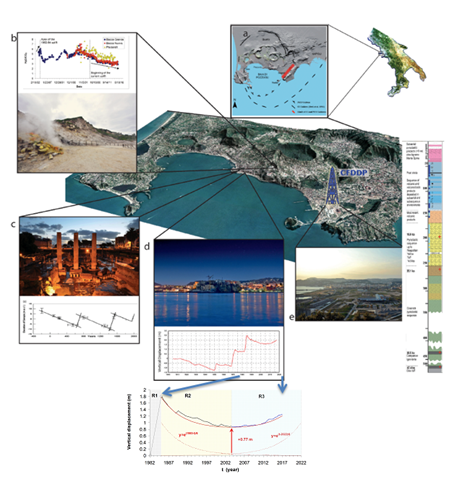
Image - The figure shows the Campi Flegrei caldera, together with the most important locations for the observations of the bradyseismic phenomenon and for recent scientific research. The upper part of the figure shows the H2O/CO2 ratio over the last 37 years, analyzed in this work together with other geochemical data collected in the fumaroles of Solfatara and Pisciarelli. The Bagnoli site of the Campi Flegrei Deep Drilling project is also shown, with the stratigraphy detected in the well, which has made it possible to redefine the extension of the Phlegraean caldera (top centre). In the figures below, the secular strain data (on the left) and from 1950 to today (on the right). In the lower part, the enlargement of the period from 1984 to the present is reported, for which the present work shows, for the first time, the specular character of the current uplift with respect to the lowering of the period 1984-2003, which suggests the same fluid deflation-inflation mechanism for both episodes.