


A recent study conducted by a research team from theIstituto Nazionale di Geofisica e Vulcanologia (INGV), Sapienza University of Rome, and the National Research Council (CNR), conducted using satellite analysis, highlights that the seismic sequence in Central Italy that began in August 2016 resulted in significant ground displacement. The measurement results could provide new insights into earthquake dynamics.
The seismic sequence that occurred in Central Italy from 24 August 2016 is linked to the extension involving the Apennines and measured via the GPS network in about 4-5 mm per year. The surprise is that thanks to new satellite technologies it has been possible to measure how the earthquake caused the lowering of a volume of the earth's crust at least 7 times greater than that lifted.
“Through the use of geodetic data and satellite interferometric techniques applied to InSAR (Interferometric Synthetic Aperture Radar) radar images”, explains Christian Bignami of INGV, “images were acquired which allowed the exact measurement of rock volumes mobilized during the earthquake of Amatrice - Norcia”.
For about twenty years, Earth observation satellites have made it possible to study seismic events. In particular, satellites equipped with a RADAR sensor, the SAR (Synthetic Aperture Radar), are used to accurately measure the deformations of the earth's surface induced by earthquakes. Located on a satellite platform in orbit around the Earth, SARs make it possible to obtain detailed information in the form of images. By applying a particular signal processing technique, SAR Interferometry (InSAR), it is possible to analyze and measure ground movements. “SAR interferometry”, explain Christian Bignami and Emanuela Valerio, “has made it possible to extract information about the distance that each point (image pixel) on the ground has with respect to the SAR, thus allowing the measurement of the variations that have occurred in the area 'photographed' by satellite following the earthquake. It was thus possible to calculate the lowering and lifting of the ground, and the related volumes of rock mobilized by the seismic events that occurred on August 24, 2016 with a magnitude of 6 and on October 30, 2016 with a magnitude of 6.5”.
The results obtained pose a very important question: where does this excess crustal mass end up? The model predicts that in the preparatory phase of the earthquake, which can last a few hundred years, a few thousand micro-fractures form in the fragile crust (the first 10-15 km) linked to the ongoing extension along the Apennine chain and therefore the creation of an "expanded" volume which, having reached a limit state in which it is no longer able to support the weight of the overlying rocks, the expanded volume collapses, welcoming the excess volume which lowers during the earthquake, like the closure of an accordion.
"In particular, thanks to these data", adds INGV President Carlo Doglioni, "the ratio between rock volume in subsidence and volume in uplift was evaluated, shedding new light and confirmation on the role of gravity in earthquakes related to faults extend them. The next objective is the hunt for crustal volumes in which there are dilated zones along the Apennines, prone to generating a future seismic event.
The study Volume unbalance on the 2016 Amatrice - Norcia (Central Italy) seismic sequence and insights on normal fault earthquake mechanism, authors C. Bignami, E. Valerio, E. Carminati, C. Doglioni, R. Lanari and P. Tizzani, is was published in the journal Scientific Reports-Nature.
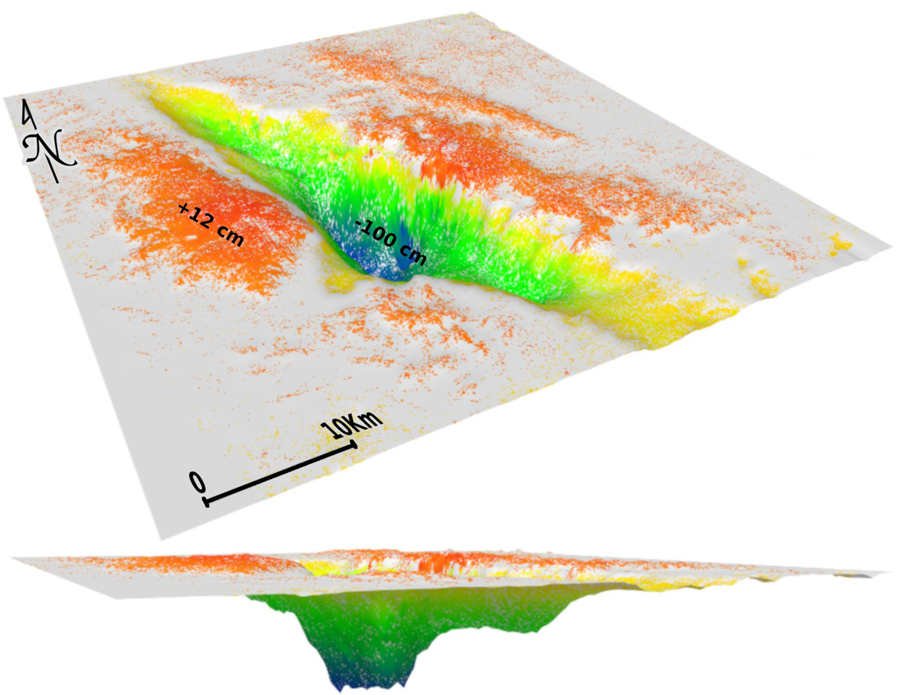
Image - The figure shows a 3D view of the ground deformation that occurred during the seismic sequence between 24 August and 30 October 2016. The deformation is here exaggerated by about 5000 times for a better representation of the phenomenon. The figure highlights the great difference between the rock volumes that have subsided (yellow-green-blue colors) and raised (orange colors). The maximum measured subsidence is about 1m against the estimated 12cm uplift. In terms of volumes, 0,12 km3 in sinking, and only 0,016 km3 in lifting were calculated. The greater volume that fell during the earthquake requires the presence in depth of a previously dilated volume capable of 'accommodating' the excess mass.
Abstract
We analyze the Mw 6.5, 2016 Amatrice-Norcia (Central Italy) seismic sequence by means of InSAR, GPS, seismological and geological data. The >1000 km2 area affected by deformation is involving a volume of about 6000 km3 and the relocated seismicity is widely distributed in the hanging wall of the master fault system and the conjugate antithetic faults. Noteworthy, the coseismically subsided hangingwall volume is about 0.12 km3, whereas the uplifted adjacent volumes uplifted only 0.016 km3. Therefore, the subsided volume was about 7.5 times larger than the uplifted one. The coseismic motion requires equivalent volume at depth absorbing the hanging wall downward movement. This unbalance regularly occurs in normal fault-related earthquakes and can be inferred as a significant contribution to coseismic strain accommodated by a stress-drop driven collapse of precursory dilatancy. The vertical coseismic displacement is in fact larger than the horizontal component, consistent with the vertical orientation of the maximum lithostatic stress tensor.
#ingv #Universitàsapienza #cnr #earthquakes #scientificreports