


Evaluation, in real time, of the possibility that an earthquake could generate a tsunami and estimate of the expected arrival times along the exposed coasts, is the mission of the INGV Tsunami Alert Center. In Paris the recognition during the assembly of the IOC-UNESCO
Today, June 27, at the UNESCO headquarters in Paris, the Tsunami Warning Center (CAT) of theIstituto Nazionale di Geofisica e Vulcanologia (INGV) has received the accreditation certificate as a Tsunami Service Provider for the Mediterranean, within the framework of the NEAMTWS (North-Eastern Atlantic and Mediterranean Tsunami Warning System).
Active in an experimental phase since 1 October 2014, after more than two years of tests carried out on earthquakes and tsunamis on a global scale, the CAT, together with its Greek, French and Turkish counterparts, was accredited during the thirteenth session of the ICG (Intergovernmental Coordination Group) – NEAMTWS in September 2016. The CAT then moved into operational mode from 1 January 2017, in agreement with the National Department of Civil Protection (DPC).
On 5 June, the publication in the Official Gazette of the Prime Minister's Directive, called SiAM (National Alert System for Seaquakes (SiAM) generated by earthquakes in the Mediterranean Sea), made the Italian alert system formal and operational, coordinated from the DPC, in which the CAT plays a primary and delicate role.
In fact, the CAT-INGV operates 24 hours a day, assessing in real time the possibility that a particular earthquake, with its epicenter at sea or in the immediate vicinity, could generate a tsunami, and estimating the expected arrival times along the exposed coasts. The messages issued by the CAT are then transmitted to the DPC which has the task of disseminating them to the structures and components of the national civil protection service to reach the potentially affected population as quickly as possible.
Earthquakes are the main cause of tsunamis (about 80%), although they are not the only one. In any case, earthquake-induced tsunamis are the only ones for which it is possible, with current monitoring networks, to define an alert system on a regional scale. Other causes can be underwater or coastal landslides or volcanic eruptions.
The CAT-INGV also makes use, as indicated in the SiAM Directive, of the data of the National Mareographic Network of the Higher Institute for Environmental Protection and Research (ISPRA) and of the other Mediterranean mareographic networks for the verification of a possible tsunami.
In the period October 2014 - June 2017, the CAT analyzed hundreds of seismic events of magnitude greater than 5.5 in all coastal areas of the world. Five of these earthquakes originated in the Mediterranean, particularly in the Greek islands, in the Gibraltar area off the coast of Morocco, and in Cyprus. For these events, the CAT-INGV sent the alert messages within a few minutes of the time of origin of each earthquake.
At the moment there are nine countries that have subscribed to the CAT-INGV services: Egypt, France, Germany, Greece, Israel, Italy, Lebanon, Portugal, Turkey, and three international bodies: IOC (Intergovernmental Oceanographic Commission of UNESCO), ERCC (Emergency Response Coordination Center of the European Commission), JRC (Joint Research Center of the European Commission).
In addition to the head of the INGV Tsunami Warning Center, Alessandro Amato, also the Tsunami National Contact for Italy in the UNESCO-IOC area, the DPC engineer Luigi D'Angelo, and the President of the Intergovernmental Oceanographic Commission were present at the ceremony (COI) at UNESCO, Rosalia Santoleri.
Rome, June 27 2017
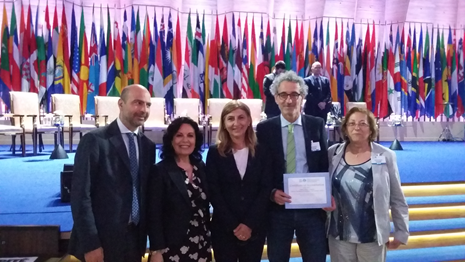
Photo 1 – UNESCO Paris: the Tsunami Warning Center (CAT) of theIstituto Nazionale di Geofisica e Vulcanologia (INGV) receives its accreditation certificate as a Tsunami Service Provider. From left to right: Luigi D'Angelo (DPC); Vincenza Lomonaco (Italian Ambassador to UNESCO); Giusi Nicolini (former mayor of Lampedusa); Alessandro Amato (CAT-INGV manager); Rosalia Santoleri (CNR, President of the Italian National Olympic Committee)
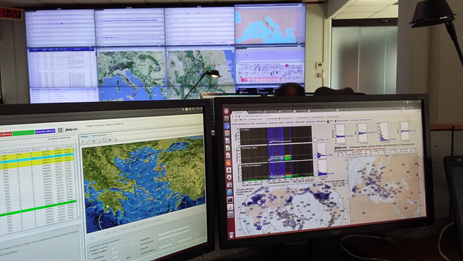
Photo 2 - Analysis underway during the recent 6.5 earthquake in the Aegean Sea, which generated a small tsunami between the Turkish coast and the Greek islands (Lesvos)